The next few months were spent frantically re-supplying the Jane and Beaufoy for a third voyage to the Antarctic. Although the major purpose was for sealing, Weddell now had instructions that if no seals were found he should 'prosecute a search beyond the track of former navigators'. This appealed immensely to Weddell, who was more an explorer than a sealer, and the ships were duly equipped with three chronometers, compasses, barometers, thermometers, logbooks, charts, and the new steel pens and graphite pencils. Weddell commanded the Jane, with 22 crew, while the Beaufoy, with 13 men, was given to Matthew Brisbane (c.1787-1833), a Scotsman from a seafaring family. The two ships sailed from the Thames on 13.9.22, and after entering the Atlantic separated: the Jane steering for Madeira, and the Beaufoy for the Cape Verde Islands. By 14.10.22 both ships were off Bonavista in the Cape Verdes. After taking on supplies they sailed on 20.10.22 and crossed the equator on 7.11.22. During the crossing the Jane developed a serious leak, requiring an anchorage to be found on the coast of Patagonia. After searching around the Valdes Peninsula (10.12.22), a harbour was found at Port St Elena on 19.12.22. While repairs on the Jane were being carried out the Beaufoy went sealing along the Patagonian coast. By 1.1.23 the two vessels were in company again, midway between the Patagonian coast and South America, where they searched for an island, the 'Aigle Reef', which had been reported by a variety of navigators, particularly Captain Bristow in 1819, and the whaler captain Robert Poole, of the Aigle. Finding nothing, they arrived off the South Orkney Islands on 12.1.23, anchoring between Saddle Island and Melville Island (= Laurie Island). Sealing proved disappointing, so the two ships headed south, and by 27.1.23 had reached 64º58'S. Weddell, wanting to make use of the long periods of daylight, then turned north to look for land between the South Orkneys and South Sandwich Islands, and on 1.1.23 was at 58º50'S. Weddell was now convinced that nothing new remained to be discovered in those latitudes, and that he should search further to the south. Following the 40ºW line of latitude, the two ships reached 66ºS on 10.2.23, and a week later at 71º10'S were rapidly approaching the furthest south penetrated by any ship in the Southern Ocean. The season was unusually mild and tranquil, and 'not a particle of ice of any description was to be seen'. By 17.2.23 the two ships had reached 74º34'S, 30º12'W. A few icebergs were sighted but there was still no sight of land, leading Weddell to theorize that the sea continued as far as the South Pole. Another two days' sailing would have brought him to Coats Land but, to the disappointment of the crew, Weddell decided to turn back. The region would not be visited again until 1911, when Wilhelm Filchner discovered the ice shelf which now bears his name. Weddell returned north roughly along the 40º line of latitude, passed by the South Orkneys and sheltered at South Georgia, where he and his crews searched for the elusive seal. On 17.4.23 they sailed from South Georgia bound for the Falklands, and on 11.5.23 anchored off New Island. After wintering at the Falklands the two ships sailed on 7.10.23 for the South Shetlands. They survived a ferocious hurricane but were prevented from approaching the islands by thick pack ice, and on 18.11.23 Weddell turned west to search for seals around Cape Horn. On 23.11.23 the Jane and Beaufoy dropped anchor in Wigwam Cove, ten miles north of Cape Horn, and during December made another fruitless attempt to reach the South Shetlands, still locked in ice. In the first week of 1824 the two ships separated: Brisbane and the Beaufoy stayed in Tierra del Fuego until 20.1.24; Weddell cruised the Patagonian coast as far as the Santa Cruz River, then returned to the Falklands on 2.3.24. Seventeen days later Weddell sailed for Patagonia to rendezvous with Brisbane, but by that time the Beaufoy had set off on the homeward voyage and was to arrive in the Thames on 20.6.24. Weddell encountered severe storms, and a leak in the Jane forced him to put in at Montevideo. Repairs completed, the Jane sailed from the Río de la Plata on 4.5.24 and reached the Thames on 9.7.24. His record for a southerly voyage, three degrees beyond that of Cook, caused some raised eyebrows. Rather than confronting the Admiralty with numerous charts and records, Weddell was persuaded by Strachan and Mitchell to incorporate everything in a book, thereby adding credence to his discoveries. The first edition appeared in 1825. In August 1824 Brisbane sailed the Beaufoy from the Thames for a return voyage to Patagonia, Tierra del Fuego, and the Falklands, with particular instructions to revisit the Fuegian islanders they had encountered two years earlier. Brisbane returned to England on 14.4.26 and Weddell added a short account of the voyage, mainly concerning the Fuegians, to the second, enlarged edition of his book published in 1827.
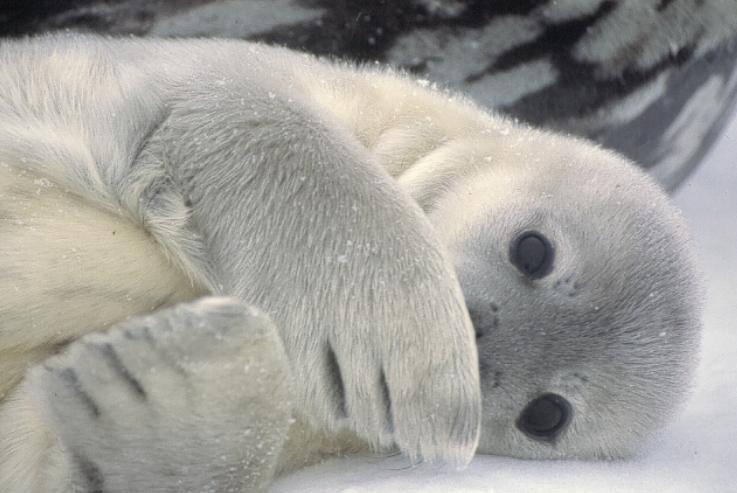
Weddell Seal